

Satellite-based MRV for land-intensive supply chains
Above-ground biomass estimation, land-use change accounting, and removals quantification built for frameworks such as GHG Protocol LSRS, SBTi FLAG, CSRD, TNFD and EUDR.
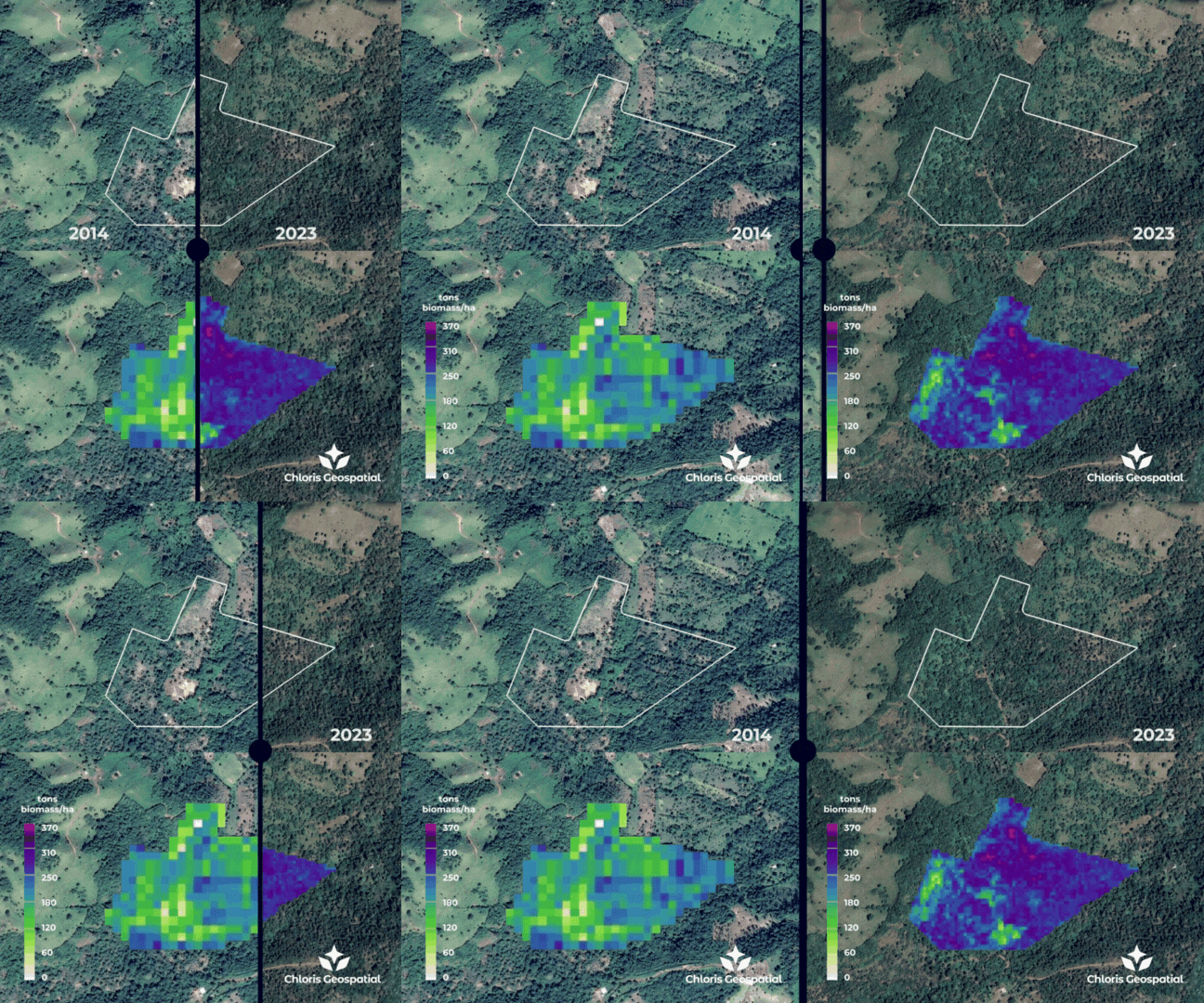
Agroforestry and carbon removals. Coffee farm, Nicaragua.
Trusted by the leading brands setting the standard




From biomass to balance sheet
Most MRV tools are built for project-level carbon markets.
Chloris is built to operate at enterprise supply chain scale.
Annual biomass measurements from 2000 to present.
Year-over-year consistency means no unexpected true-up costs and credible baselines for science-based target-setting.
Enterprise-grade scale
API access for enterprise integration, volume pricing, and commodity-specific data layers — not just generic forest coverage.
Audit-ready by design
Every measurement comes with methodology documentation, 95% confidence intervals, and a clear documentation trail from satellite source data to final figure.
Not because auditors might ask, but because that rigor is built into how Chloris operates.
25 years of data continuity
Applicable to all major frameworks
Major standards are converging on land-intensive supply chains between now and 2027.
Chloris is designed to meet all of them simultaneously.
-
Effective January 2027
Land Sector and Removals Standard
The most significant update to corporate land accounting in a decade. LSRS encourages spatial traceability and site-level primary data, replacing static emission factors and generic reference periods. Companies with FLAG supply chains will need to rebuild their GHG inventories from the ground up.
→ Chloris: 25 years of spatially explicit biomass data, LSRS-aligned dynamic baselines, and annual monitoring cadence.
-
Targets due 2025–2030
Science-Based Targets for Land, Forests and Agriculture
Land-intensive companies must set and track science-based targets covering FLAG emissions: land use change, agricultural emissions, and land-based removals. Credible target-setting requires a defensible historical baseline. Removal claims can also be supported by additionality proof against a dynamic counterfactual.
→ Chloris: dynamic baselines, agroforestry removal quantification, and year-over-year monitoring built for FLAG target tracking.
-
Enforceable December 2026
EU Deforestation Regulation
Large and medium operators placing regulated commodities on the EU market must prove deforestation-free status with plot-level geolocation data and a full due diligence statement. Covers cattle, cocoa, coffee, palm oil, soy, wood, and rubber. A simplification review is due April 2026 but core obligations remain intact.
→ Chloris: plot-level deforestation monitoring with baselines back to 2000, supply shed coverage, and audit-ready documentation across all regulated commodities.
-
Phased 2024–2026
EU Corporate Sustainability Reporting Directive
Mandatory sustainability reporting for thousands of European companies. For land-intensive supply chains, two ESRS standards are directly relevant: ESRS E1 (climate change, covering Scope 3 FLAG emissions) and ESRS E4 (biodiversity and ecosystems, requiring site-level nature impact assessments). Generic data won't survive double-materiality assessment.
→ Chloris: primary, site-specific biomass and land cover data for both ESRS E1 Scope 3 FLAG inventories and ESRS E4 ecosystem disclosures.
-
Voluntary, growing fast
Taskforce on Nature-related Financial Disclosures
TNFD's LEAP approach requires companies to identify nature dependencies and impacts at the asset and site level. Uptake is accelerating as investors and lenders begin using TNFD disclosures in portfolio risk assessment.
→ Chloris: site-level biomass, canopy, and land cover data structured for TNFD LEAP assessments across sourcing geographies.
We have experience in all commodities worldwide.

Where Chloris is genuinely different
25 years of global above-ground biomass measurements, field-calibrated in-country for regional accuracy
Direct satellite-based AGB tracking — not land cover proxies
Captures degradation and carbon stock change that land cover approaches miss
A dedicated service layer for complex supply chains
Data calibration tailored to your specific geographies and commodities
GIS Analysts translate measurements into submission-ready outputs
A long-term partner through disclosure cycles, methodology updates, and regulatory change
Most Accurate Biomass Data
Ready to see your supply chain in 25 years of data?
Talk to our team about your timelines and data needs